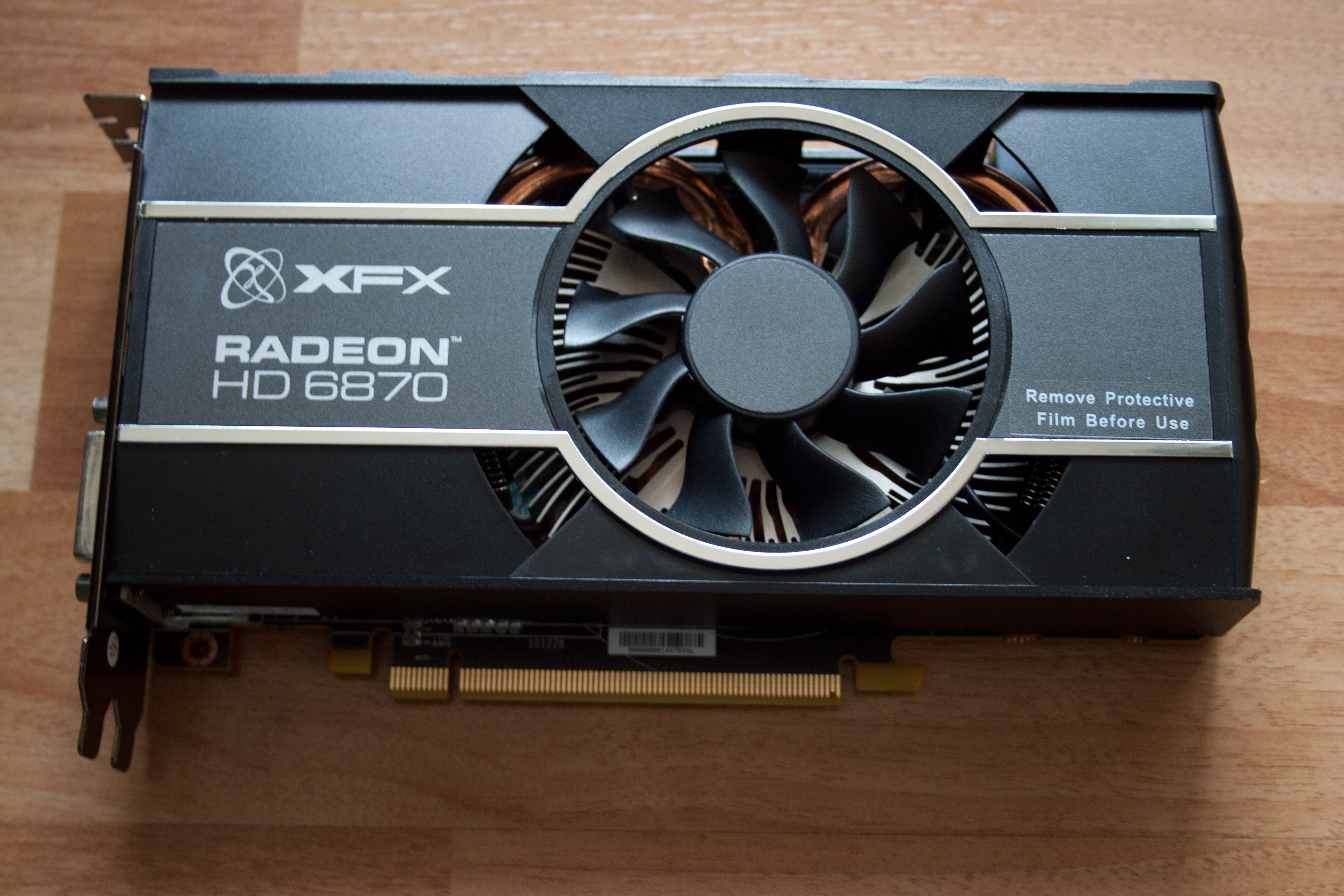
AMD Radeon HD 6870: Features and Performance
Graphics card review
AMD Radeon HD 6870: Features and Performance
The HD 6870 is worth studying because it shows what a well-aimed midrange GPU could do when vendors still had to defend every watt, dollar, and frame. I read this card as a product with a clear job: give serious 1080p performance, keep the feature list modern for its time, and avoid the thermal excess that made some enthusiast boards feel like small space heaters.
If you are comparing legacy Radeon cards, building a retro gaming tower, or trying to understand why AMD’s Barts generation mattered, the useful questions are simple: What did the card actually ship with? How did it perform in real games? How did it stack up against NVIDIA’s GeForce GTX 460 and AMD’s older Radeon HD 5800-series parts? That is the line I follow here, with the help of AMD’s own specifications, AMD’s launch announcement, Tom’s Hardware’s launch review, and later hands-on testing from Gaming Nexus and TweakTown. See also the broader blog index and the site home page for related hardware coverage.
For a quick spec reference, AMD’s legacy support page still lists the HD 6870 as a DirectX 11 card with a 900 MHz boost frequency, 1 GB of memory, dual-link DVI, HDMI, and no VGA output. Tom’s Hardware framed the launch more sharply, noting that the HD 6870 was aimed at Radeon HD 5850-class performance rather than being a simple step-up from the older 5870. That distinction matters, because it explains much of the card’s reception and much of the confusion around it.
Key Takeaways
- The Radeon HD 6870 was built on AMD’s Barts GPU and targeted the upper midrange, not the high end.
- Its main strengths were sensible power use for the era, strong 1080p gaming, and feature depth such as Eyefinity and HDMI 1.4a.
- Its main weaknesses were naming confusion, only 1 GB of VRAM, and aging driver support today.
- For retro builds, it still makes sense; for modern gaming, it does not.
Overview of the AMD Radeon HD 6870
The HD 6870 arrived on October 21, 2010, as part of AMD’s first Radeon HD 6000 launch wave. AMD’s launch material positioned the card as a competitive answer to Nvidia’s GeForce GTX 460 family, while Tom’s Hardware described it as part of a rebalanced architecture designed to occupy the $150 to $250 range rather than replace the fastest Radeon HD 5800 cards. That detail is the key to understanding the product: the 6870 was not a halo GPU, and AMD never really wanted it to be one.
I think that explains the card’s reputation better than a simple rank order ever could. In this segment, buyers cared about three things: whether a card could handle demanding games at 1920×1080, whether it would fit into a normal desktop without power drama, and whether it brought enough new features to justify a purchase over a discounted older board. The HD 6870 answered yes to the first two and “mostly yes” to the third.
AMD’s own support page still lists the card under its legacy driver model, which is a useful reminder that the HD 6870 belongs to a different era of PC graphics. It has the hardware feature set of a DirectX 11 board, but it does not belong in a conversation about current-generation gaming, modern upscaling stacks, or contemporary media workflows. If you want the present-day driver picture, AMD’s legacy support page is the right place to start: AMD Radeon HD 6870 previous drivers.
Still, the HD 6870 remains relevant as a benchmark in judgment. It shows how much performance AMD could extract from a relatively restrained board design, and it shows how much perceived value depends on product naming, market timing, and the competition sitting next to it on the shelf.
Key Features and Specs
The HD 6870’s specification sheet was respectable for its moment. AMD’s current legacy page lists the board with a boost frequency up to 900 MHz, 1 GB of memory, dual-link DVI, HDMI, and DirectX 11 support. Gaming Nexus’ launch coverage fills in the rest of the picture: 1120 stream processors, 4200 MHz effective GDDR5 memory, two 6-pin power connectors, and a dual-slot cooler. Together, those details define the card far better than the model name does.
| Spec | AMD Radeon HD 6870 | What it meant in practice |
|---|---|---|
| GPU | Barts XT | AMD’s midrange rework of the Radeon HD 5000-era design. |
| Stream processors | 1120 | Enough shader throughput for strong 1080p gaming in 2010-2011. |
| Core clock | 900 MHz | High enough to keep the card competitive without demanding exotic cooling. |
| Memory | 1 GB GDDR5 | Fine for the launch window, but the first hard limit you feel in later years. |
| Memory interface | 256-bit | Enough bandwidth for the card’s intended class. |
| Power connectors | 2 x 6-pin PCIe | Not minimal, but still manageable in a normal gaming PSU. |
| Outputs | DVI, mini-DisplayPort, HDMI | A practical mix for multi-monitor work and home theater use. |
| Special features | DirectX 11, Eyefinity, HD3D, UVD 3 | The feature set was one of the card’s main selling points. |
The feature mix is where the card starts to make more sense. AMD leaned hard on multi-display support with Eyefinity, and later reviews consistently treated that as a genuine advantage for users who wanted more than one display without buying an expensive workstation board. AMD also included HDMI 1.4a support and updated video decode capabilities, which mattered to buyers who wanted a card that could do more than just draw polygons.
There was another side to this story: physical design. The HD 6870 was still a dual-slot board, and several partner cards used fairly substantial coolers. That was not a mistake. It was the tax paid to keep thermals and noise reasonable while staying within the power budget of the class. On a clean, well-built card, that tradeoff was sensible.
For readers who like to verify launch context, AMD’s original announcement is still useful: AMD’s Radeon HD 6800 launch release. The phrase AMD used then was ambitious; the market response was more restrained, which is usually how reality corrects marketing.
Performance Review
Performance is where the card earns its keep. The simplest summary is this: the HD 6870 delivered convincing 1080p-era results, especially in older or well-optimized games, but it did not rewrite the performance ladder. Tom’s Hardware described the card as slower than the Radeon HD 5870, even while AMD’s own launch narrative emphasized new features and better efficiency. That sounds like contradiction until you remember the target: AMD was trying to reset value, not claim the absolute crown.
Gaming performance
Gaming Nexus tested the HD 6870 with a reference-like setup and reported that the card ran at 900 MHz with 1120 stream processors and a 4200 MHz memory clock. Their review concluded that the card offered good performance for the price and could stand beside more expensive hardware in several real games. TweakTown later found that an overclocked XFX variant could deliver a minimum of 40 FPS in Far Cry 2 with anti-aliasing and anisotropic filtering turned on. That is not a modern victory lap, but it is solid evidence that the board had real headroom in its intended era.
Tom’s Hardware’s launch review is useful because it places the 6870 in the real competitive map. The site explicitly said AMD was aiming at the GeForce GTX 460 1 GB and 768 MB class, and that the Radeon HD 6870 promised roughly Radeon HD 5850-class performance. In other words, the card was supposed to land in a useful neighborhood, not win a spec-sheet arms race.
In practical terms, that meant the HD 6870 could handle the sorts of games people actually played in 2010 and 2011 at reasonable settings. It was comfortable in many DirectX 11 titles, could be tuned for higher quality in older games, and gave users enough headroom to make anti-aliasing and anisotropic filtering part of the conversation instead of an immediate surrender.
Synthetic benchmarks
Legit Reviews’ ASUS HD 6870 review reported that the card scored well over 4000 in both the 3DMark 11 Performance and Extreme presets. That is a broad statement rather than a single chart value, but it is still valuable because it shows the card had enough synthetic muscle to remain relevant in a benchmark that was deliberately harsh for its time.
Used carefully, synthetic benchmarks tell us the right kind of boring truth. They do not settle every debate, but they do show whether a card is fundamentally in the right class. The HD 6870 was. It was a respectable DirectX 11 board, and it behaved like one.
Thermals and power
Power and cooling are the part of the story that casual buyers often skip, and then regret later. Gaming Nexus measured the card at roughly 15 W idle and 150 W under full load for the reference HD 6870. TweakTown found the XFX Black Edition to be unusually cool, reporting a 61 C load temperature and describing the card as one of the coolest HD 6870 samples it had tested. That is a useful contrast: the GPU class itself was efficient enough for the period, but actual cooler quality still mattered a lot.
AMD’s original marketing emphasized energy efficiency, and on this point the company was not wrong. The card needed two 6-pin power connectors, so it was not exactly frugal, but it also did not demand the power supply overkill that came with some of the era’s top-end boards. A normal quality PSU and decent airflow were enough. That sounds obvious now; it was less obvious in the age of hot, noisy flagships.
| Performance area | What the evidence says | Why it matters |
|---|---|---|
| 1080p gaming | Strong for its class, especially in older and well-optimized titles | That was the card’s primary job. |
| Modern synthetic tests | Still capable of clearing the bar in older benchmark suites | Shows the card had real launch-day substance, not just marketing. |
| Thermals | Dependent on partner cooler quality; good samples could run cool | Used cards vary a lot here. |
| Power draw | 150 W load in Gaming Nexus testing | Manageable for mainstream systems, but not cheap enough to ignore. |
Comparison with Other Models
Comparison is where the HD 6870 gets interesting, because it is easy to misread the card if you only look at the name. AMD’s own launch material said the HD 6800 series offered more than 30 percent greater game performance than competing products in its class, but the company also admitted that the 6870 was not meant to outrun the older HD 5870. Tom’s Hardware was blunter, saying the 6870 was slower than the 5870 and that the product should be understood as a rebalanced midrange part.
I would frame the comparison like this: the HD 6870 was better positioned than the HD 5870 if price and power mattered more than raw heritage, but it was not a universal upgrade. Against Nvidia’s GTX 460 1 GB, it was a close and genuinely relevant competitor. Against the HD 5850, it lived in the same neighborhood, which is exactly where AMD wanted it to sit.
| Card | How it compares to the HD 6870 | Best interpretation |
|---|---|---|
| NVIDIA GeForce GTX 460 1 GB | Direct competitor | The fight AMD wanted. In many buyers’ minds, the real choice was value versus value. |
| AMD Radeon HD 5850 | Comparable performance class | Useful if the price gap favored the newer card or if features mattered more. |
| AMD Radeon HD 5870 | Often faster | Better raw performance, but not the clean replacement some buyers assumed. |
| NVIDIA GeForce GTX 560 Ti | Later, stronger competitor | Shows how quickly the market moved after the 6870’s launch window. |
The useful lesson here is that “better” depends on the criteria. If your criterion is raw chart position, the HD 6870 does not look heroic against the fastest older Radeon boards. If your criterion is balanced cost, features, and practical 1080p performance, it looks much healthier. That is why I prefer decision tables to tribal labels. Hardware is expensive enough without pretending every comparison has one winner.
For readers who want an additional contemporary test of the launch position, Tom’s Hardware’s launch review remains one of the most readable starting points: Tom’s Hardware’s HD 6870 launch review. It is old now, but so is the card. Age is not an argument against evidence.
User Experiences
Reviews tell you what a GPU can do. User experience tells you what it is like to live with one after the excitement has gone away. On that front, the HD 6870 gathered a familiar mix of praise and complaint. People liked the card’s reasonable temperature behavior, its solid 1080p gaming at launch, and the fact that it did not require a high-end power supply or an unusually exotic case layout. In other words, it was a card that fit into normal life rather than demanding a shrine.
Complaints were equally predictable. The first was naming confusion. Buyers saw “6870” and assumed “faster than 5870,” which was not always the case. The second was the 1 GB framebuffer. That was fine when the card was new, but it eventually became the limiting factor in newer games and heavier texture settings. The third is one every legacy card eventually inherits: driver support stops advancing, and AMD now places the board under legacy downloads instead of active feature development.
That last point matters more than enthusiasts sometimes admit. A card can still be physically functional while being software-frozen. For a retro machine, that is acceptable. For a system that needs current game compatibility, security, and media support, it is a hard stop. You can still enjoy the board, but you should not confuse nostalgia with suitability.
If you want the driver reality directly from AMD, the legacy support page is plain about it: previous drivers for the Radeon HD 6870. That is not dramatic. It is just the adult version of hardware life.
Common praises
- Good 1080p performance for the era
- Useful feature set with Eyefinity and HDMI 1.4a
- Reasonable thermals with a decent cooler
- Easy to slot into a mainstream gaming tower
Common complaints
- Naming made the card look faster than it was
- 1 GB of VRAM is now the obvious constraint
- Legacy driver status limits modern usefulness
- Used cards can have fan wear or aging thermal paste
What It Means for Buyers Now
If I had to give the HD 6870 a buying recommendation in 2026, it would be narrow and specific. Buy it only if you are building a period-correct PC, repairing an older system, or collecting hardware from the first DirectX 11 generation. In those contexts, the card remains useful and easy to understand. It was never ridiculous, and it is still not ridiculous.
For everyone else, the answer is simpler: there are better cards at almost every price point, and modern software expects much more from a GPU than the HD 6870 can provide. Newer cards bring stronger media engines, better efficiency, larger frame buffers, and active driver support. That is not a moral judgment. It is just the part where time collects its debt.
So the decision criteria are straightforward:
- Choose the HD 6870 if you need a legacy card for a legacy build and the price is low enough to treat it as a hobby purchase.
- Choose a newer GPU if you want current game support, modern drivers, and a larger safety margin in texture-heavy titles.
- Choose a different AMD card from the same era only if you have a specific power, output, or cooler preference that changes the equation.
That is the sort of answer I trust. It is not glamorous, but it prevents expensive regret.
Conclusion
The AMD Radeon HD 6870 was a serious midrange card built for a specific moment in GPU history. It offered the right mix of DirectX 11 support, competitive 1080p performance, and practical features like Eyefinity and HDMI 1.4a. It also carried the usual compromises of its class: a 1 GB framebuffer, a dual-slot cooler, and a market position that confused buyers who read the model number too literally.
I would summarize it this way: the HD 6870 was not AMD’s fastest board, but it was one of AMD’s more disciplined ones. It solved a real problem for a real audience, and the evidence from AMD’s specs, Tom’s Hardware’s launch review, Gaming Nexus, Legit Reviews, and TweakTown all points in the same direction. It was capable, balanced, and in the right build, genuinely useful.
If you are exploring more MaximoNET hardware pages, the next sensible stops are the blog index and the home page. For this card in particular, the final verdict is plain: good legacy hardware, poor modern purchase, and a useful case study in how to judge graphics cards by criteria instead of nostalgia.
| Verdict factor | Assessment |
|---|---|
| Launch value | Strong |
| Legacy gaming | Good |
| Modern gaming | Poor |
| Used-buy recommendation | Only for specific retro or repair cases |